How Long Each Type of Soap Needs to Cure
Cure times by recipe type, what is actually happening during the cure, and which of the numbers everyone repeats are measured rather than inherited.
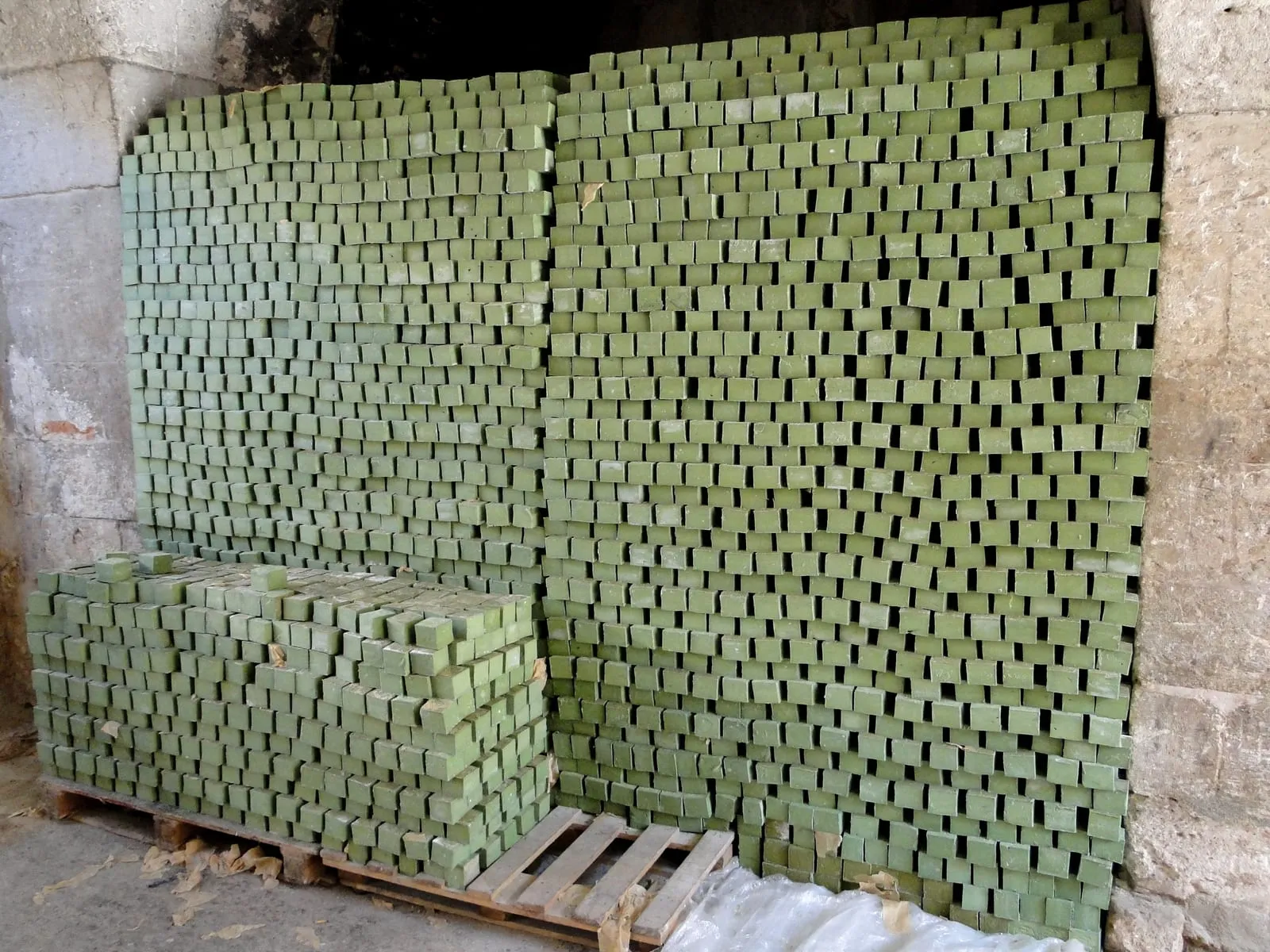
Four weeks is the working minimum for a balanced cold process bar and six is the comfortable default, but olive-heavy and castile bars need months. Saponification finishes in about 48 hours. The rest of the cure is water leaving and crystals reorganising.
A cold process bar is chemically soap within about 48 hours. It will still be a poor bar for another month. The cure is not a safety waiting period and it is not tradition for its own sake. It is two physical processes running slowly, and the difference between a week-old bar and a six-week-old one is obvious the first time you compare them in the shower.
What is actually happening
Water is leaving
A fresh bar is roughly a third water by weight, from the lye solution. Over the cure, most of it evaporates. Everything people like about a well-made bar follows from that loss:
- It gets harder. A soft bar deforms in a wet dish and washes away.
- It lasts far longer. A properly cured bar can outlast an under-cured one from the same batch by a factor of two or more, because it is not dissolving on contact.
- The lather changes. Denser and creamier rather than thin and quick to collapse.
The crystals reorganise
The less-discussed half. Soap is a crystalline solid, and freshly saponified soap sets into a disordered mix of crystal forms. As water leaves, the fatty acid salts have room to rearrange into a more ordered, stable packing.
This is why cure time improves lather even in bars that have already lost effectively all their water. It is also why a very old bar of good soap, a year or two old, is often the best it will ever be.
The timeline
| Age | State |
|---|---|
| 24–48 hours | Saponification essentially complete. Soft, high water content, still alkaline on the tongue-test. |
| 3–7 days | Firm enough to cut and bevel. Usable in an emergency; will dissolve fast and feel harsh. |
| 2 weeks | Noticeably harder. Lather still thin. |
| 4 weeks | The usual minimum for sale. Good hardness, proper lather, mild. |
| 6 weeks | The comfortable default for most blends. |
| 3–6 months | High-olive and castile bars come into their own. These genuinely need the long cure. |
| 1 year+ | Still improving, if stored with airflow. Bars high in linoleic acid may show orange spots by now. |
Blends high in oleic acid, meaning olive-heavy recipes and castile especially, are the ones that reward patience most. A pure castile at four weeks is a slimy disappointment. At six months it is superb.
How to cure properly
The failure mode is not curing too little time, it is curing in the wrong conditions. Water has to have somewhere to go.
- Airflow on every face. A wire rack, not a solid tray. Bars standing on edge with a finger of space between them.
- Turn them. Once or twice a week, so the face that was down gets its turn.
- Cool, dry, dark. Heat is fine; humidity is the enemy, and direct sunlight fades natural colourants and speeds rancidity.
- Never in a sealed box. Boxing a bar before it has dried traps the moisture and gives you a soft bar and a mould risk. Box only when the cure is done.
- Weigh, if you want certainty. Put one bar on a scale and record it weekly. When the weight stops falling, the cure is done. This is the only method that answers the question rather than estimating it.
Two things curing is not
It is not neutralising leftover lye. If a recipe was calculated correctly with a normal superfat, there was never free alkali to neutralise. A bar that is caustic at four weeks was caustic at day one and is a formulation or measurement error, not a cure problem. Waiting will not fix it.
It is not the same as hot process. Hot process cooks the reaction to completion, so those bars are usable within a day or two. But they still benefit from drying: a hot process bar cured for a month is harder and longer-lasting than one used immediately. Different chemistry, same physics.
Why so much soap on the market skips it
Because a cure is expensive. It is six weeks of stock sitting on a rack in a climate-controlled room, unsold, taking up space. Under-curing is how a maker converts their inventory into cash faster, and the customer absorbs the cost as a bar that disappears in two weeks.
It is a fair thing to ask about. A maker who cures properly will know exactly how long, and will tell you.
Sources
- secondaryHandcrafted Soap & Cosmetic Guild: resource centreTrade-association guidance on lye discount, which is why a correctly formulated bar has no free alkali for a cure to neutralise.
Read next
All articles →
Buying Well
Why Handmade Soap Costs More Than a Supermarket Bar
A handmade bar can cost several times a supermarket one. Where that money goes: the oils, the weeks on a curing rack, the glycerine, and the work done by hand.
The Craft
Why Real Soap Is Alkaline, and What pH-Balanced Bars Really Are
True soap always tests alkaline, usually between pH 8 and 11. Here is why that follows from the chemistry, and what a bar sold as pH 5.5 actually contains.
Buying Well
How to Read a Soap Label Without Being Sold To
Saponified oils, INCI names, syndet bars and the word natural. A practical guide to telling real cold process soap from a decorated commercial base.